 |
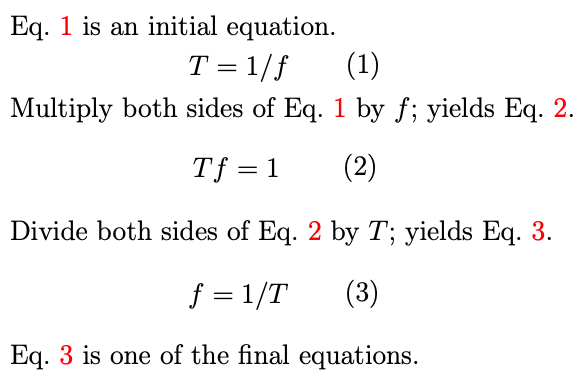
A statement about period, \(T\), and linear frequency, \(f\) like "\(T=1/f\) is equivalent to \(f=1/T\)" can be made more explicit by explaining the steps:
The mathematical expression of the relation is \(T=1/f\). To express frequency as a function of period, multiply both sides of the expression by \(f\) to get a new expression, \(T\ f=1\). Then divide both sides of the second expression by \(T\) to yield the third expression, \(f=1/T\).
That narrative text can be represented by a graph that links expressions and steps:
|
Can all known mathematical physics be documented in a way that can be both read by humans and checked by a computer algebra system?
To investigate that question the Physics Derivation Graph provides a schema and software infrastructure for mathematical physics.
For the impatient user, see the Physics Derivation Graph navigation. More context for students, instructors, and researchers is available.
Terminology: In the above example there are three expressions: \(T=1/f\), \(T\ f=1\), and \(f=1/T\). Each expression is defined by a left-hand side, a relation operator (here "="), and a right-hand side. Two instances of the Equivalence relation relate the three expressions. These relations between expressions are called inference rules. The generic form of the first inference rule used in the example is "multiply both sides of an expression by a quantity to yield a new expression." Similarly, the second inference rule is generically, "divide both sides of an expression by a quantity to yield a new expression."
Implementation: Relations in Physics derivations are enacted using a a Neo4j property graph database. The can be exported to other formats like CSV and JSON; see the PDG navigation page.
Motivation: Mathematical Physics uses the tools of math applied to measurements of our environment. In Physics existing knowledge can be written down. That written record can be checked for correctness by a computer algebra system.
Use the Physics Derivation Graph navigation, or read the FAQ, or review the documentation.
See also other related or similar projects, literature review, and experiments in annotation.